-
Custom Software Development
Custom Software Development Process: From Idea to Launch
July 29, 2026 — By Brain Technosys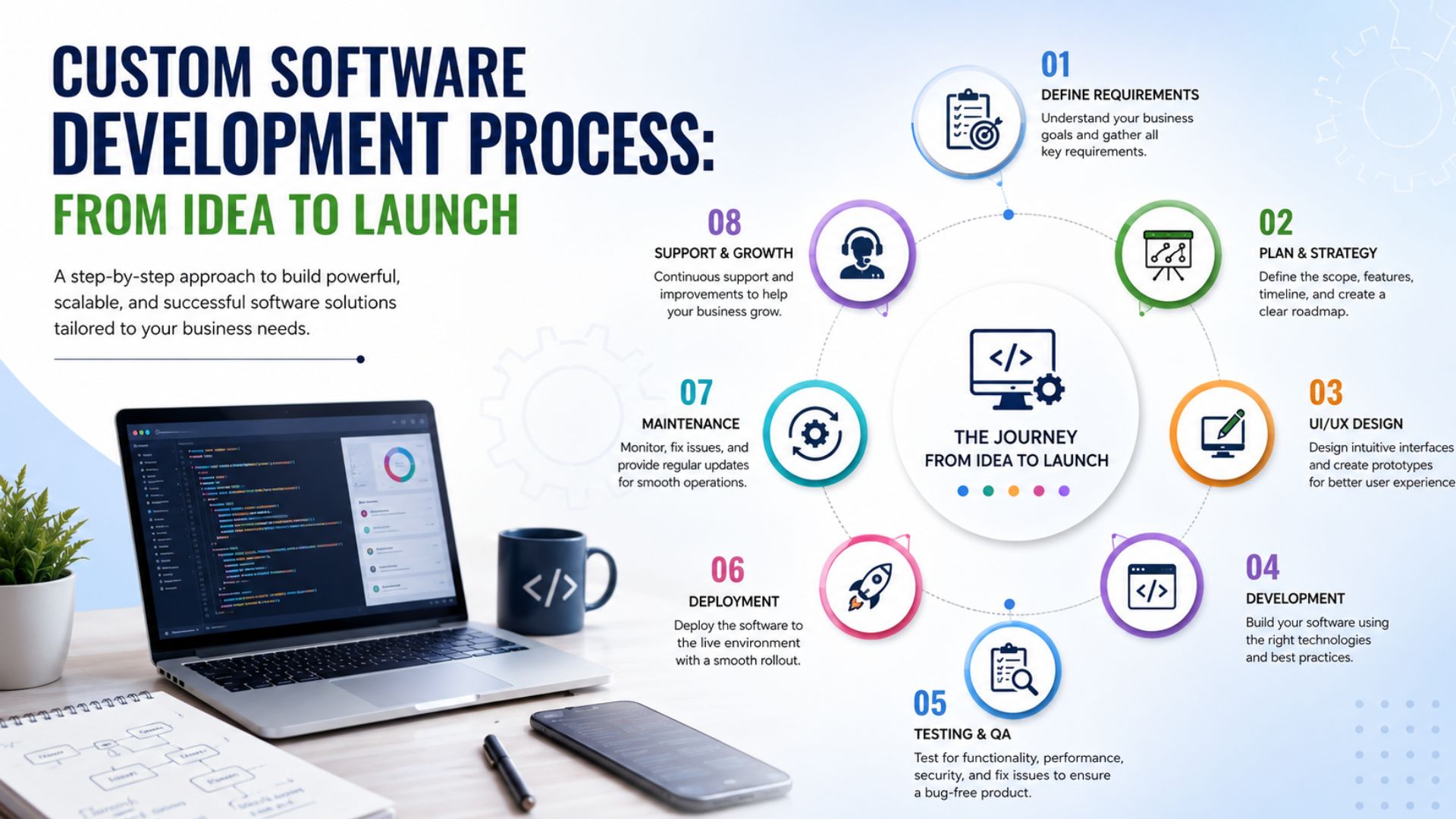
Building successful software requires more than simply writing code. A structured custom software development process helps businesses turn an idea into a reliable, scalable, and secure product. From understanding business requirements and planning the project to design, development, testing, deployment, and ongoing support, every stage contributes to the final result. This guide explains the complete software development process step by step, so businesses can understand what happens during custom software development services and what to expect from an idea through to launch.
What Is the Custom Software Development Process?
The custom software development process is a structured approach used to plan, design, build, test, launch, and maintain software created for a specific business or organization.
Unlike ready-made applications, custom software is developed around particular business workflows, users, goals, and technical requirements. The process normally starts with understanding the problem the software needs to solve and ends with deployment and ongoing improvements.
A well-planned process helps reduce development risks, control project scope, improve software quality, and ensure that the final product supports real business needs.
Why a Structured Development Process Matters
A clear development process gives everyone involved a better understanding of what needs to be built, when it should be completed, and how success will be measured.
Without proper planning, projects can experience unclear requirements, unexpected costs, delays, security issues, or features that users do not actually need.
A structured approach keeps business owners, designers, developers, and other stakeholders aligned throughout the project.
Step 1: Define Your Business Requirements
The first stage of custom software development is understanding the business problem and defining what the software needs to accomplish.
Before development begins, the team needs to understand the company’s current processes, target users, challenges, and desired outcomes.
Identify Business Goals and Challenges
Start by identifying why the software is needed.
For example, a business may want to reduce manual data entry, improve customer management, automate internal processes, connect multiple systems, or provide customers with a better digital experience.
Clearly defining these goals helps the development team focus on solving real business problems instead of simply adding features.
Gather Software Requirements
The next step is to document the software requirements. These may include user roles, required features, integrations, security expectations, reporting needs, and performance requirements.
For example, an eCommerce business may require product management, inventory tracking, payment integration, customer accounts, order processing, and reporting.
Clear requirements create a strong foundation for the rest of the software development process.
Step 2: Project Planning and Scope Definition
Once the requirements are understood, the project can be planned in more detail.
This stage establishes what will be developed, how the work will be organized, and what resources will be required.
Define Project Scope and Features
Project scope describes what the software will and will not include.
The development team can prioritize essential features for the first version while identifying additional functionality that can be introduced later.
This approach can help prevent scope creep and keep development focused on the most important business objectives.
Create a Development Roadmap
A development roadmap outlines the major stages of the project, expected milestones, responsibilities, and deliverables.
It provides businesses with visibility into the project and helps the development team organize design, development, testing, and deployment activities.
Good planning also makes it easier to identify potential technical or operational risks before development moves too far forward.
Step 3: UI/UX Design and Prototyping
After planning, designers focus on how the software will look and work for its users.
Good UI/UX design is not only about creating an attractive interface. It is about making the software easy to understand, efficient to use, and suitable for the people who will interact with it.
Creating User-Friendly Interfaces
The design process considers navigation, screen layouts, buttons, forms, dashboards, mobile responsiveness, and overall user flow.
For business applications, the interface should make common tasks simple and reduce unnecessary steps.
A well-designed product can improve user adoption because people are more likely to use software when they can understand it without extensive training.
Testing Ideas with Prototypes
A prototype provides an early visual representation of the software before full development begins.
Businesses can review the proposed user journey and identify changes while the project is still at the design stage.
Making improvements early is generally easier than changing a fully developed feature later.
Step 4: Software Architecture and Technology Selection
The technical foundation of the application is established during this stage. Developers determine how different components of the system will work together and select technologies that fit the project’s requirements.
Choosing the Right Technology Stack
The technology stack may include programming languages, frameworks, databases, cloud platforms, APIs, and other development tools.
The choice should be based on factors such as functionality, performance, security, scalability, development requirements, and long-term maintenance.
There is no single technology stack that is suitable for every project. The right choice depends on the type of application and its business requirements.
Planning Scalability and Security
A good architecture should consider future growth from the beginning.
If a business expects more users, larger data volumes, additional integrations, or new functionality in the future, the architecture should be capable of supporting those changes.
Security should also be considered at this stage, including authentication, authorization, data protection, secure APIs, and appropriate access controls.
Step 5: Custom Software Development
Once the design and technical architecture are approved, developers begin building the application.
This is where the planned features and workflows are converted into working software.
Building Core Features and Functionality
Developers build the core features according to the approved requirements and designs.
Depending on the project, this could include user accounts, dashboards, payment systems, booking functionality, inventory management, reporting, communication tools, or administrative features.
The development process should remain connected to the original business objectives so that every major feature has a clear purpose.
API Integration and Third-Party Services
Many modern applications need to communicate with external platforms.
APIs can connect software with payment gateways, CRM platforms, cloud services, maps, communication tools, analytics systems, or other business applications.
Proper integration allows different systems to exchange information and can help businesses automate processes that would otherwise require manual work.
Step 6: Software Testing and Quality Assurance
Testing is an essential part of custom software development. Before launch, the software needs to be checked to make sure it works as expected and provides a reliable experience for users.
Functional and Performance Testing
Functional testing checks whether features perform according to their requirements.
For example, developers may test whether users can register successfully, submit forms, complete payments, generate reports, or update information correctly.
Performance testing examines how the application behaves under different workloads and helps identify issues related to speed, stability, or system capacity.
Security and Usability Testing
Security testing helps identify weaknesses that could expose systems or data to unauthorized access.
Usability testing focuses on whether users can navigate and complete important tasks without unnecessary confusion.
Testing from both technical and user perspectives helps improve the quality of the final product.
Step 7: Software Deployment and Launch
Once testing is completed and major issues have been resolved, the software can be prepared for production.
Deployment means moving the application into the environment where real users will access it.
Preparing for Production
Before launch, the team may configure servers, databases, domains, cloud infrastructure, security settings, backups, monitoring, and access permissions.
A final review should confirm that the application is ready for real-world use.
Launching the Software
Depending on the project, software can be launched to all users at once or introduced gradually.
A controlled rollout can help the team monitor performance, collect feedback, and identify unexpected issues before expanding access.
A successful launch is not the end of the project. It is the beginning of the software’s operational life.
Step 8: Software Maintenance and Support
After deployment, software still requires regular maintenance. Businesses change, technologies evolve, and users may identify new requirements over time.
Monitoring and Fixing Issues
Ongoing monitoring can help identify performance problems, errors, security concerns, and other issues.
Technical support allows these problems to be investigated and resolved before they significantly affect users or business operations.
Updates, Improvements, and Scalability
Software maintenance and support can include security updates, performance improvements, bug fixes, new integrations, and additional features.
As the business grows, the application may also need to support more users, larger amounts of data, or new workflows.
This ongoing approach helps scalable software solutions remain useful long after the initial launch.
How Long Does Custom Software Development Take?
There is no fixed timeline for every custom software development project.
A simple application with a limited number of features may take considerably less time than a large enterprise platform requiring multiple integrations, complex workflows, advanced security, and extensive testing.
The timeline depends on factors such as project scope, number of features, technical complexity, integrations, design requirements, testing, and feedback cycles.
The best way to estimate a project timeline is to define the requirements and scope before development begins.
Common Challenges in Custom Software Development
Even well-planned projects can face challenges. Identifying them early can help businesses prepare better.
Changing Requirements
Business needs can change during development. New requirements should be evaluated carefully because significant changes can affect the timeline, budget, and technical architecture.
Integration and Technical Challenges
Connecting new software with existing systems can sometimes be complicated, particularly when older systems or third-party platforms are involved.
Proper technical planning and testing can help reduce integration problems.
Maintaining Quality and Security
Software needs to be both functional and secure. Skipping testing or treating security as an afterthought can create problems after launch.
Including quality assurance and security throughout the development lifecycle is a better approach than addressing major issues only at the end.
How to Choose the Right Custom Software Development Company
Choosing the right custom software development company can have a significant impact on project quality and long-term results.
Look for a development partner that understands your business requirements, communicates clearly, follows a structured development process, and has experience with technologies relevant to your project.
It is also useful to evaluate previous work, development practices, testing processes, security approach, post-launch support, and communication methods.
The goal should not simply be to find a team that can build software. You need a partner that understands the business problem and can turn it into a practical, maintainable solution.
Frequently Asked Questions
What are the stages of custom software development?
The main stages include requirements gathering, project planning, UI/UX design, technical architecture, development, testing, deployment, and ongoing maintenance and support.
How long does custom software development take?
The timeline depends on the project’s scope, features, technical complexity, integrations, testing requirements, and feedback cycles. A clearly defined project scope provides a more accurate estimate.
How much does custom software development cost?
The cost depends on factors such as functionality, number of users, integrations, technology choices, design requirements, security needs, and development time. A detailed requirements analysis is needed to provide a realistic estimate.
What happens after software development is completed?
After development, the software is tested, deployed, monitored, and maintained. Post-launch support may include bug fixes, security updates, performance improvements, and new features.
Why is software testing important?
Testing helps identify functional errors, performance problems, usability issues, and security weaknesses before they affect real users. It is an important part of delivering reliable software.
Final Thoughts
A successful software product is built through a combination of clear requirements, thoughtful planning, good design, reliable development, thorough testing, and ongoing support. Following a structured custom software development process helps businesses turn an initial idea into a solution that can support real operational needs.
Whether you are building a customer-facing application, an internal business platform, or a complex enterprise system, choosing the right custom software development services and planning each stage carefully can make the difference between a product that simply works and one that creates lasting business value.
Recent Posts
-

Benefits of AI for Businesses: How Artificial Intelligence Drives Growth
September 17, 2026
-

What Is AI Software Development? A Complete Guide for Businesses
September 11, 2026
-

Benefits of Custom Software Development for Modern Businesses
September 2, 2026
-
Hire the Best Angular Developers - Brain Technosys
August 21, 2026
-
Categories
- .NET development
- Agile Project Management
- AI development
- android app development
- Angular Developer
- Apps Development
- Bing Webmasters
- Blog Marketing
- Cloud Services
- Custom Software Development
- Digital Marketing
- E-Commerce
- Flutter App Development
- Google Adwords
- google map
- Google Update
- Google Webmasters
- Hire Developers
- HTML
- internet marketing
- Ios App Development
- iphone app development
- Local SEO
- magento development
- MEAN vs MERN Stack Development
- mobile app development
- Mobile Update
- News & Events
- PPC
- Search Engine Optimization
- Seo
- Social Media Marketing
- Tech
- Uncategorized
- Web Design
- Web Development
- Web Hosting
- WooCommerce Development


