-
Custom Software Development
Custom Software vs Off-the-Shelf Software: Which Is Right for Your Business?
July 27, 2026 — By Brain Technosys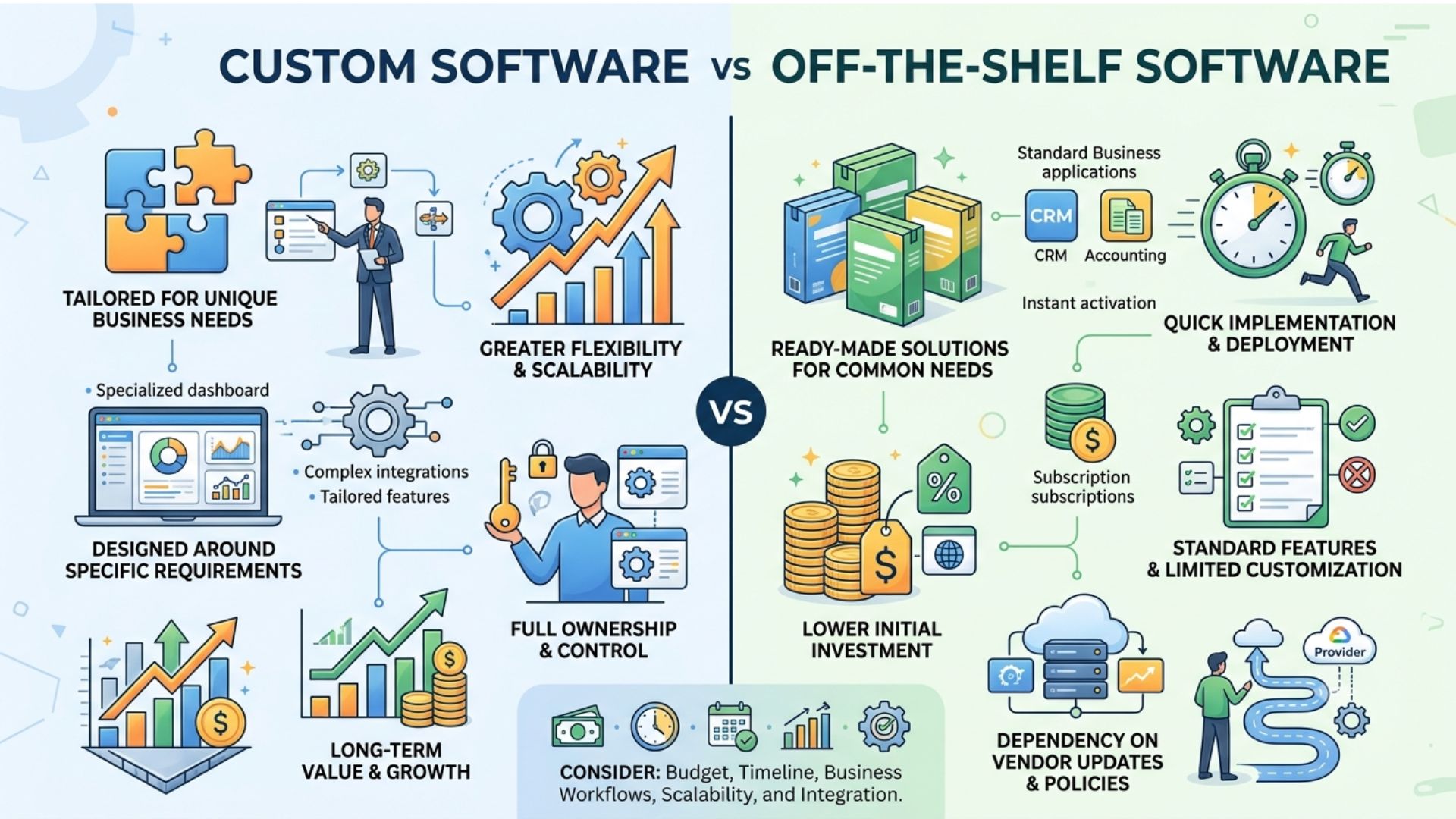
Choosing the right software can have a major impact on how efficiently a business operates and grows. While off-the-shelf software provides ready-made features for common business needs, custom software is designed specifically around the requirements of a particular organization.
The right choice depends on several factors, including business processes, budget, scalability, security, integrations, and long-term goals. In this guide, we will compare custom software vs off-the-shelf software, explain their key differences, and help you understand which solution may be the right fit for your business.
Custom Software vs Off-the-Shelf Software: An Overview
Businesses have different goals, workflows, and technology requirements. Some organizations need a solution that can be implemented quickly, while others require software built around unique business processes. Understanding the difference between custom software services and off-the-shelf software is the first step toward making an informed decision.
What Is Custom Software?
Custom software is developed specifically for the requirements of a particular business or organization. Its features, workflows, integrations, and functionality are designed around the way the business operates.
For example, a company may need one platform that combines inventory management, customer information, reporting, and internal workflows. Instead of changing its processes to fit a generic tool, the business can use a custom software solution designed around its specific requirements.
This approach provides greater flexibility and allows the software to evolve as the business grows.
What Is Off-the-Shelf Software?
Off-the-shelf software is a ready-made solution developed for a broad range of businesses and users. It usually includes standard features that address common business requirements.
Examples include accounting platforms, project management tools, CRM systems, and subscription-based business applications. These solutions are often quicker to implement and may require less initial investment.
However, businesses may need to adapt their workflows to match the software, and customization options can sometimes be limited.
Why Businesses Compare These Software Solutions
Choosing between custom software and off-the-shelf software is not simply about selecting the cheapest or fastest option. Businesses need to consider how well the software supports their current operations and future goals.
A ready-made solution may be suitable for organizations with standard requirements. However, businesses with unique workflows, complex integrations, or specific scalability needs may benefit more from custom software development.
Factors such as customization, cost, security, integration, scalability, maintenance, and long-term value should all be considered before making a decision.
Key Differences Between Custom and Off-the-Shelf Software
The main difference between custom software and off-the-shelf software is how each solution is designed and used. Custom software is built around the specific requirements of one business, while off-the-shelf software is created for a wider audience with standard features.
Customization and Flexibility
Custom software development gives businesses greater control over features and workflows. The software can be designed to match specific operational requirements, while ready-made solutions generally offer limited customization options.
Features and Functionality
Off-the-shelf software comes with pre-built features designed for common business needs. Custom software solutions, on the other hand, allow organizations to choose the functionality they actually need.
This can help businesses avoid unnecessary features and create a more focused user experience.
Scalability and Business Growth
As a business grows, its software requirements may change. Custom software can be expanded with new features, users, integrations, and capabilities as business needs evolve.
With off-the-shelf software, scalability often depends on the features and pricing plans offered by the software provider.
Integration with Existing Business Systems
Modern businesses often use multiple tools and platforms to manage their operations. Custom software development services can help create solutions that integrate with existing CRM systems, ERP platforms, accounting software, cloud services, and third-party APIs.
This can reduce manual data transfer and create a more connected workflow.
Custom Software vs Off-the-Shelf Software: A Detailed Comparison
Development and Implementation
Off-the-shelf software is already developed, allowing businesses to implement it quickly. This can be useful when an organization needs an immediate solution.
Custom software development involves several stages, including planning, design, development, testing, and deployment. Although the process usually takes longer, the final solution is built around the organization’s specific needs.
Cost and Pricing
Ready-made software often has a lower initial cost and may follow a monthly or annual subscription model. However, long-term expenses can include licensing fees, upgrades, additional users, and premium features.
Custom software usually requires a larger initial investment, but it can provide long-term value by reducing dependency on multiple software tools and recurring subscription costs.
The right decision should be based on the total cost of ownership rather than only the initial price.
Security and Data Control
Security is an important consideration for every business. With a custom software solution, security features can be designed around the organization’s specific requirements and data protection needs.
With off-the-shelf software, businesses generally depend on the provider’s security infrastructure, policies, and updates.
Maintenance and Updates
Ready-made software updates are controlled by the vendor. Businesses may receive automatic updates, but they may have limited control over when changes are introduced.
With custom software development, businesses can decide which features, improvements, integrations, and security updates are required as their needs change.
Ownership and Vendor Dependency
Businesses using off-the-shelf software depend on the provider’s pricing, policies, features, and product roadmap.
A custom solution provides greater control over the software’s future development and allows businesses to plan improvements according to their own goals.
Advantages of Custom Software Development
Built Around Your Business Requirements
One of the biggest advantages of custom software development is that the solution is designed around the specific goals, workflows, and challenges of an organization.
Instead of changing business processes to fit generic software, companies can build technology that supports the way they already work.
Greater Scalability and Flexibility
A growing business may need new features, users, integrations, or automation in the future. Custom software solutions can evolve alongside the organization, making it easier to support long-term growth.
Better Integration and Automation
Custom software development services can help businesses connect different applications and automate repetitive tasks. This can reduce manual work, improve data accuracy, and make everyday operations more efficient.
Long-Term Business Value
Although custom software may require a higher initial investment, it can provide long-term value through improved productivity, better control, greater flexibility, and reduced dependency on multiple software tools.
Advantages of Off-the-Shelf Software
Faster Implementation
Since off-the-shelf software is already developed, businesses can usually implement it much faster than a custom solution.
This makes it suitable for organizations that need a solution immediately.
Lower Initial Investment
Ready-made software often has a lower upfront cost. This can make it an attractive option for startups and businesses that need standard features without a large initial investment.
Ready-Made Features and Support
Many ready-made platforms include pre-built features, documentation, customer support, and regular updates provided by the vendor.
For businesses with standard requirements, these features may be sufficient.
When Should You Choose Custom Software?
Custom software development may be the better choice when your business has unique workflows that cannot be effectively managed by standard tools.
It can also be useful when you need advanced integrations, specific security requirements, or a platform that can scale with long-term business growth.
Your Business Has Unique Workflows
If your operations require specialized processes that standard software cannot support, a custom software solution can be designed around your exact requirements.
You Need Advanced Integrations
Businesses that need to connect multiple systems, APIs, databases, or third-party platforms may benefit from custom software development services designed for seamless integration.
Your Business Is Planning Long-Term Growth
A custom solution can be expanded as the business grows. This makes custom software a suitable option for organizations with long-term technology and scalability goals.
When Is Off-the-Shelf Software a Better Choice?
Off-the-shelf software can be a practical choice when a business has standard requirements and needs a solution quickly.
It may also be suitable for organizations with limited initial budgets or those that do not require extensive customization.
You Need a Solution Quickly
Ready-made software can often be implemented immediately, allowing businesses to start using the required features without waiting for development.
Your Business Has Standard Requirements
If a business only needs common features such as basic accounting, project management, or customer management, off-the-shelf software may be sufficient.
You Have a Limited Initial Budget
Businesses with limited budgets may prefer subscription-based software because it usually requires a lower initial investment.
Custom Software vs Off-the-Shelf Software: Which Is Better?
There is no single solution that is best for every business. The right choice depends on your business requirements, budget, operational complexity, and long-term goals.
Off-the-shelf software may be suitable for businesses that need standard features quickly. Custom software may be a better option for organizations that require unique functionality, advanced integrations, greater scalability, and long-term control.
The best approach is to evaluate what your business needs today and how those requirements may change in the future.
How to Choose the Right Software Solution for Your Business
Before choosing between custom software and off-the-shelf software, businesses should carefully evaluate their operational and technical requirements.
Define Your Business Requirements
Start by identifying the problems you want the software to solve. Consider your workflows, users, required features, and business objectives.
Consider Your Long-Term Goals
Think about how your business may grow in the future. A solution that works today may not be suitable as your operations expand.
Evaluate Scalability and Integration Needs
Consider whether the software needs to connect with existing systems and whether new features or users may need to be added later.
Consider Total Cost of Ownership
Do not focus only on the initial price. Consider licensing fees, subscriptions, maintenance, upgrades, integrations, and long-term operational costs.
Frequently Asked Questions
Is custom software better than off-the-shelf software?
Custom software can be better for businesses with unique requirements, while off-the-shelf software may be more suitable for standard business needs.
Is custom software more expensive?
Custom software generally requires a higher initial investment, but it can provide long-term value through better efficiency, flexibility, and scalability.
Can off-the-shelf software be customized?
Some off-the-shelf software allows customization through settings, plugins, or integrations. However, customization may be limited compared to software built specifically for a business.
Which software is better for a growing business?
A growing business may benefit from custom software development when it requires greater scalability, unique workflows, or advanced integrations. However, the right choice depends on its specific needs.
How do I choose the right software solution?
Evaluate your business requirements, budget, scalability needs, integration requirements, security expectations, and long-term goals before making a decision.
Final Thoughts
The choice between custom software and off-the-shelf software depends on what your business actually needs. Ready-made software can be a practical option for standard requirements and quick implementation, while custom software development provides greater flexibility, scalability, and control for businesses with unique needs.
By carefully evaluating your current operations and future goals, you can choose a software solution that supports long-term growth and delivers meaningful business value.
Recent Posts
-

Benefits of AI for Businesses: How Artificial Intelligence Drives Growth
September 24, 2026
-

What Is AI Software Development? A Complete Guide for Businesses
September 11, 2026
-

Benefits of Custom Software Development for Modern Businesses
September 2, 2026
-
Hire the Best Angular Developers - Brain Technosys
August 21, 2026
-
Categories
- .NET development
- Agile Project Management
- AI development
- android app development
- Angular Developer
- Apps Development
- Bing Webmasters
- Blog Marketing
- Cloud Services
- Custom Software Development
- Digital Marketing
- E-Commerce
- Flutter App Development
- Google Adwords
- google map
- Google Update
- Google Webmasters
- Hire Developers
- HTML
- internet marketing
- Ios App Development
- iphone app development
- Local SEO
- magento development
- MEAN vs MERN Stack Development
- mobile app development
- Mobile Update
- News & Events
- PPC
- Search Engine Optimization
- Seo
- Social Media Marketing
- Tech
- Uncategorized
- Web Design
- Web Development
- Web Hosting
- WooCommerce Development


