-
AI development
Benefits of AI for Businesses: How Artificial Intelligence Drives Growth
September 24, 2026 — By Brain Technosys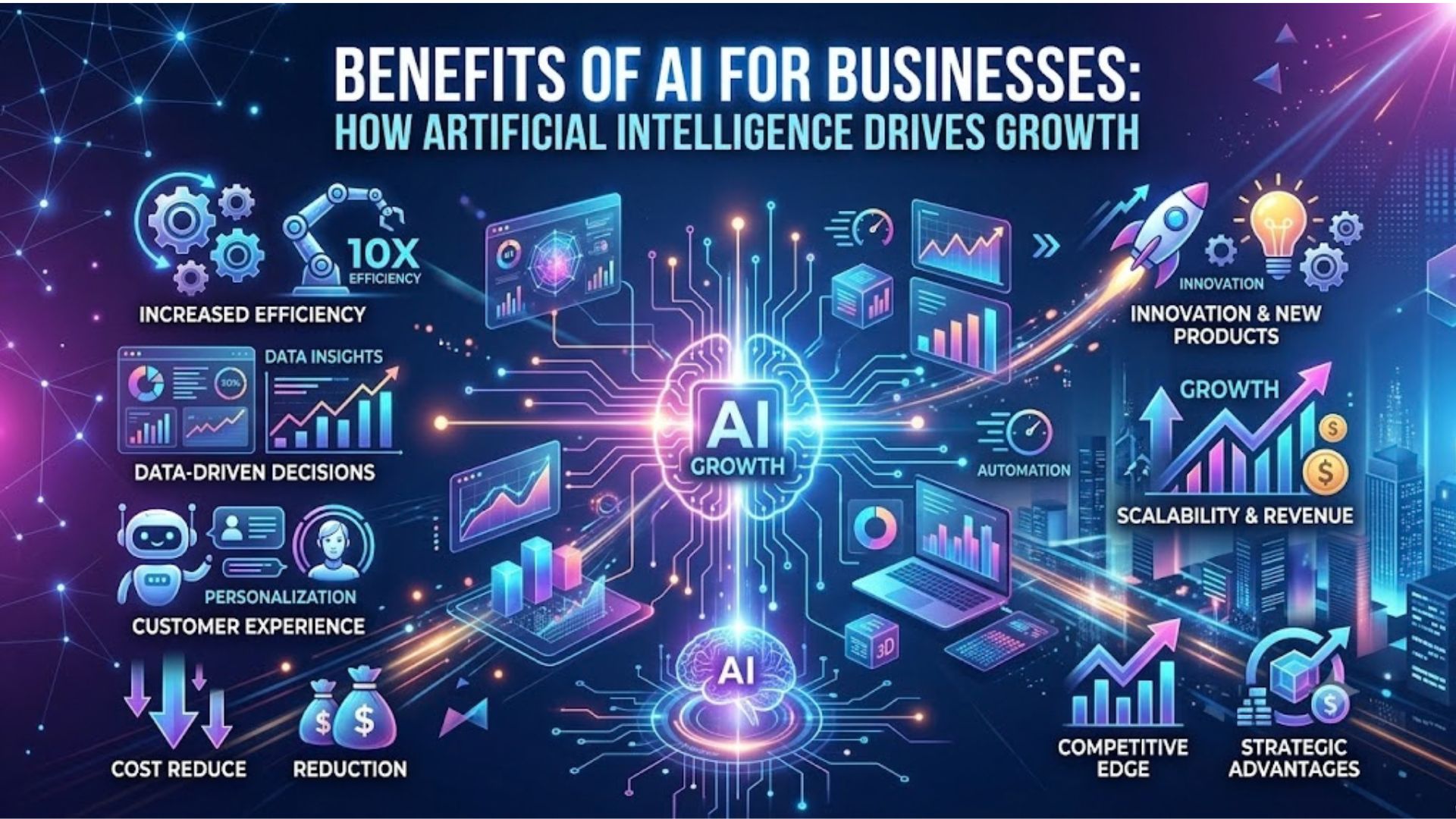
Artificial intelligence is no longer limited to research labs or large technology companies. Businesses across industries are using AI to automate routine work, understand data, improve customer experiences, and make better-informed decisions.
From customer support and sales to finance, operations, and software development, AI can support many areas of a business. However, the real value of AI does not come from simply adding an AI tool. It comes from applying the right technology to a genuine business need.
For companies considering AI adoption, understanding the benefits of AI for businesses is an important first step. It helps decision-makers identify where AI can create practical value, what challenges to expect, and how to approach implementation in a structured way.
What Is AI for Business?
AI for business refers to the use of artificial intelligence technologies to perform tasks, analyse information, identify patterns, automate processes, and support decisions that would traditionally require human effort.
Depending on the business requirement, AI can include machine learning, natural language processing, computer vision, generative AI, predictive analytics, and other related technologies.
For example, an online retailer can use AI to recommend products based on customer behaviour. A financial company may use AI to identify unusual transaction patterns. A customer service team can use AI-powered systems to answer common questions and route complex requests to the right employee.
The important point is that AI should support a clear business objective. It may help a company save time, improve accuracy, understand customers better, or make existing processes more efficient.
Businesses looking to understand the technology at a deeper level can also explore our guide to What Is AI Software Development?.
Why Are Businesses Adopting Artificial Intelligence?
The amount of information businesses handle today has increased significantly. Customer interactions, transactions, operational records, documents, market data, and digital activity can create valuable insights, but analysing everything manually can be difficult.
This is where AI can become useful.
Businesses are adopting artificial intelligence to handle repetitive tasks, process large amounts of information, identify patterns, and provide useful insights faster. AI can also work alongside existing software and business systems rather than requiring every process to be replaced.
Another reason for AI adoption is customer expectations. People increasingly expect faster responses, personalised experiences, convenient digital services, and quick access to information.
When implemented properly, AI can help businesses respond to these expectations while allowing employees to focus on work that requires creativity, judgement, communication, and problem-solving.
Key Benefits of AI for Businesses
The value of AI can vary depending on the industry, business model, data, and specific use case. However, several benefits are common across many organisations.
Automate Repetitive Business Tasks
One of the most practical benefits of AI is automation.
Many businesses still spend considerable time on repetitive activities such as data entry, document processing, appointment scheduling, email classification, customer enquiries, reporting, and information extraction.
AI can assist with these activities and reduce the amount of manual work involved.
For example, an AI-powered system can categorise incoming customer requests and send routine queries to an appropriate workflow. More complex requests can then be passed to an employee.
This does not necessarily mean replacing people. In many cases, the goal is to remove repetitive work so employees can spend more time on higher-value responsibilities.
Improve Business Decision-Making
Businesses make decisions based on information every day. The challenge is often finding the right information and understanding what it means.
AI can analyse large datasets and identify patterns that may not be immediately obvious through manual analysis.
For example, a company may use AI to analyse sales trends, customer behaviour, operational performance, or demand patterns. These insights can support planning and help decision-makers evaluate different options.
AI does not remove the need for human judgement. Instead, it can provide additional information that helps people make more informed decisions.
Increase Operational Efficiency
AI can help businesses identify bottlenecks and improve the way work moves through an organisation.
For example, an AI system may identify delays in a workflow, predict demand, automate approvals, or help employees find relevant information more quickly.
Over time, these improvements can make everyday operations more efficient.
The biggest gains often come when AI is connected to existing business processes instead of being used as an isolated tool.
Enhance Customer Experiences
Customers increasingly expect businesses to understand their needs and provide quick, relevant support.
AI can help businesses deliver more personalised experiences by analysing customer interactions, preferences, purchase history, and other relevant information.
Common examples include:
- Personalised product recommendations
- AI-powered customer support
- Automated responses to common questions
- Customer sentiment analysis
- Personalised marketing content
- Intelligent search and recommendations
For businesses operating online, these capabilities can improve how customers interact with digital products and services.
Turn Business Data Into Useful Insights
Businesses often have large amounts of data but limited time to analyse it.
AI can help process structured and unstructured information and identify trends, relationships, and patterns.
For example, a company could analyse customer feedback to identify recurring complaints. A sales organisation could examine historical information to understand purchasing behaviour. An operations team could analyse performance data to identify potential inefficiencies.
This makes data more useful for everyday business planning rather than simply storing it for reporting purposes.
Reduce Operational Costs
AI can contribute to cost reduction by improving efficiency and reducing unnecessary manual work.
For example, automation can reduce the time employees spend on repetitive processes. Predictive systems can help businesses plan resources more effectively, while AI-powered support can handle common customer enquiries before human intervention is required.
However, AI implementation also involves development, integration, maintenance, and infrastructure costs. The objective should therefore be measurable business value rather than automation for its own sake.
Improve Forecasting and Planning
AI can analyse historical and current information to identify patterns that may help businesses with forecasting.
Depending on the use case, this can support areas such as:
- Demand forecasting
- Sales planning
- Inventory management
- Financial forecasting
- Workforce planning
- Customer behaviour analysis
Better forecasting can help businesses prepare for changes instead of relying entirely on assumptions or historical averages.
Support Business Innovation
AI can also create opportunities for businesses to develop new products, services, and digital experiences.
Companies can use AI to create intelligent applications, personalised services, recommendation systems, conversational interfaces, and data-driven products.
This means AI is not only about improving existing processes. It can also become part of a company’s wider digital transformation strategy.
How AI Helps Different Business Functions
AI can be applied across different departments depending on the organisation’s requirements.
AI in Marketing and Sales
Marketing teams can use AI to analyse customer behaviour, segment audiences, personalise campaigns, identify trends, and support content workflows.
Sales teams can use AI to analyse leads, prioritise opportunities, identify customer patterns, and automate parts of the sales process.
The goal is to help teams spend more time on strategy and customer relationships rather than repetitive analysis.
AI in Customer Support
Customer support is one of the areas where AI adoption is particularly visible.
AI-powered chat systems can answer frequently asked questions, provide information, collect initial customer details, and direct complex cases to human agents.
A well-designed system can provide support outside traditional working hours while still allowing employees to handle situations that require human judgement.
AI in Finance and Accounting
Finance teams deal with large volumes of financial information, making automation and analysis valuable.
AI can support tasks such as document processing, transaction analysis, financial forecasting, anomaly detection, and reporting workflows.
Human review remains important, particularly for sensitive financial decisions and compliance-related processes.
AI in Human Resources
HR departments can use AI to support recruitment workflows, employee enquiries, document processing, workforce analysis, and internal support.
For example, AI can help employees find information about company policies or assist HR teams in organising large amounts of workforce data.
Any AI application involving employees or candidates should be designed with appropriate privacy, fairness, and governance considerations.
AI in Supply Chain and Operations
AI can help businesses analyse demand, inventory, logistics, supplier information, and operational performance.
Predictive systems can support planning and help businesses identify potential disruptions or changes in demand.
This can be particularly useful for organisations managing complex supply chains or large operational networks.
AI in Software Development
AI is also changing the way software teams work.
Development teams can use AI to support code analysis, testing, documentation, debugging, software maintenance, and other development activities.
Businesses developing their own intelligent applications can also integrate AI capabilities directly into their software products.
For companies exploring broader custom software development, AI can become part of a larger solution designed around specific business workflows and requirements.
AI Business Use Cases Across Industries
AI is not limited to one particular industry. Its applications depend on the problems a business needs to solve.
AI for Retail and eCommerce
Retailers can use AI for product recommendations, demand forecasting, customer segmentation, inventory planning, fraud detection, and personalised shopping experiences.
AI for Healthcare
Healthcare organisations can explore AI for areas such as medical information analysis, administrative automation, patient support, scheduling, and research.
Because healthcare data is highly sensitive, privacy, security, accuracy, and regulatory requirements are particularly important.
AI for Financial Services
Financial organisations can use AI for fraud detection, risk analysis, customer service, transaction monitoring, forecasting, and document processing.
These applications often require strong security and governance because financial information is highly sensitive.
AI for Manufacturing
Manufacturers can use AI to monitor equipment, predict maintenance requirements, improve quality control, analyse production data, and optimise operations.
Computer vision can also be used in certain manufacturing environments to identify defects or support inspection processes.
AI for Professional Services
Professional service businesses can use AI to analyse documents, organise information, automate administrative work, support research, and improve customer communication.
The most useful applications are usually those that fit naturally into existing workflows.
AI Automation vs Traditional Business Processes
Traditional business processes often depend heavily on manual input.
An employee may need to collect information, enter it into a system, analyse it, prepare a response, and then move the task to another department.
AI automation can reduce some of these manual steps.
For example, an AI-enabled workflow might receive a customer request, understand its content, extract relevant information, classify the request, and send it to the appropriate workflow.
The difference is not simply about making a process faster. Good AI automation can also make processes more consistent and easier to scale.
However, not every process needs AI. Simple rule-based automation may be more suitable when the workflow is predictable and does not require complex analysis.
How AI Supports Data-Driven Decision-Making
Data is valuable only when businesses can turn it into useful information.
AI can analyse large amounts of business data and identify patterns that may support decision-making.
For example, AI can help identify:
- Changes in customer behaviour
- Sales trends
- Operational inefficiencies
- Demand patterns
- Potential risks
- Product performance
- Customer preferences
This can give decision-makers a clearer picture of what is happening across the business.
AI should still be treated as a support system rather than an unquestionable source of truth. Data quality, model performance, context, and human review all matter when using AI for important decisions.
AI for Customer Experience and Personalization
Personalisation has become an important part of digital customer experiences.
AI can analyse customer interactions and behaviour to help businesses provide more relevant recommendations, content, offers, and support.
For example, an eCommerce platform can recommend products based on previous interactions. A digital service can personalise content based on customer preferences. A support system can use previous conversations to provide more relevant assistance.
The key is to use customer data responsibly and make sure personalisation provides genuine value.
Challenges of Implementing AI in Business
Although AI offers significant opportunities, implementation is not always straightforward.
Data Quality and Availability
AI systems depend heavily on data. Incomplete, inconsistent, outdated, or poorly structured data can affect the quality of AI outputs.
Businesses should therefore assess their existing data before beginning an AI project.
Security and Privacy
AI applications may process sensitive business or customer information.
Security controls, access management, data protection, and appropriate privacy practices should be considered from the beginning of the project.
Integration With Existing Systems
Many businesses already use CRM platforms, ERP systems, databases, eCommerce platforms, and other software.
Connecting AI with these systems can require careful planning and technical integration.
AI Skills and Workforce Training
Successful AI adoption requires more than technology.
Employees need to understand how new systems work, when to use them, and when human review is required.
Training and change management can therefore play an important role in AI adoption.
Cost and ROI
AI projects involve costs related to development, data preparation, infrastructure, integration, testing, and ongoing maintenance.
Businesses should define measurable objectives before implementation and evaluate whether the expected value justifies the investment.
Responsible AI and Governance
Businesses also need to consider how AI systems make decisions, how information is handled, and how potential errors are identified.
Clear governance can help organisations use AI more responsibly and consistently.
How to Implement AI in Your Business
Businesses do not need to transform everything at once. A structured approach can make AI adoption easier to manage.
Identify a Business Problem
Start with a specific problem rather than starting with a particular AI technology.
Ask where employees spend unnecessary time, where customers experience delays, or where better data analysis could improve decision-making.
Select the Right AI Use Case
Once the problem is identified, determine whether AI is actually the right solution.
Some processes may be better suited to traditional software or rule-based automation.
Assess Your Data
Review the data required for the proposed AI solution.
Consider its availability, quality, structure, security, and ownership.
Choose the Right AI Technology
Depending on the problem, the solution may involve machine learning, natural language processing, computer vision, generative AI, predictive analytics, or a combination of technologies.
Develop and Test the Solution
The AI solution should be developed and tested against realistic business requirements.
Testing should evaluate accuracy, reliability, usability, security, and how well the system performs in real-world situations.
Measure Results and ROI
Define clear metrics before launching the system.
Depending on the project, these could include processing time, customer response time, conversion rates, operational costs, employee productivity, or customer satisfaction.
Scale AI Across the Business
Once a use case proves its value, businesses can consider expanding AI into other departments or workflows.
This gradual approach can help organisations learn from real-world implementation before making larger investments.
Custom AI Software Development for Businesses
Off-the-shelf AI tools can be useful for common requirements, but some businesses have workflows that require a more specialised approach.
Custom AI software development allows businesses to build solutions around their specific processes, data, users, and operational requirements.
A custom solution may include AI-powered recommendations, intelligent document processing, predictive analytics, conversational systems, computer vision, workflow automation, or other capabilities.
For organisations considering a tailored approach, AI and Machine Learning Services can help connect business requirements with appropriate AI technologies and development strategies.
Brain Technosys focuses on developing technology solutions around real business requirements rather than adding AI simply because it is a current technology trend.
How Much Does AI Implementation Cost?
There is no single price for implementing AI in a business.
The cost can vary depending on the complexity of the project, data requirements, AI technology, integrations, development time, infrastructure, security requirements, and ongoing maintenance.
A simple AI-powered feature may require significantly less investment than a large enterprise AI platform connected to multiple business systems.
Businesses should therefore define the expected outcome first and then estimate the technology and development requirements needed to achieve it.
A dedicated guide on AI development cost can provide a more detailed breakdown of the factors that influence project pricing.
The Future of AI for Business
AI is likely to become increasingly integrated into everyday business software and workflows.
Rather than existing only as separate AI applications, intelligent capabilities are becoming part of customer platforms, business applications, analytics systems, productivity tools, and internal workflows.
Generative AI, machine learning, predictive analytics, computer vision, and intelligent automation will continue to create new opportunities across industries.
At the same time, businesses will need to pay greater attention to data security, privacy, governance, accuracy, and responsible implementation.
The organisations that gain lasting value from AI are likely to be those that connect technology with clear business objectives and measurable outcomes.
Frequently Asked Questions About AI for Business
What is AI for business?
AI for business means using artificial intelligence technologies to automate tasks, analyse data, support decisions, improve customer experiences, and solve specific business problems.
What are the main benefits of AI for businesses?
The main benefits can include process automation, improved decision-making, greater operational efficiency, better customer experiences, data analysis, forecasting, and support for business innovation.
How can AI improve business operations?
AI can analyse information, automate repetitive tasks, identify patterns, support forecasting, and help employees access relevant information more efficiently.
How does AI help with business automation?
AI can understand information and make decisions within defined workflows, allowing businesses to automate tasks such as document processing, customer enquiries, classification, recommendations, and data analysis.
What industries can benefit from AI?
AI can be applied across industries including retail, eCommerce, healthcare, finance, manufacturing, professional services, logistics, technology, and many others.
How much does AI implementation cost?
AI implementation costs depend on factors such as project complexity, data requirements, technology, integrations, development effort, infrastructure, security, and ongoing support.
How can a business start using AI?
A business can start by identifying a specific problem, evaluating whether AI is appropriate, reviewing available data, selecting a suitable use case, developing and testing the solution, and measuring the results.
What are the challenges of implementing AI?
Common challenges include data quality, security and privacy, integration with existing systems, employee training, implementation costs, ROI measurement, and responsible AI governance.
Recent Posts
-

What Is AI Software Development? A Complete Guide for Businesses
September 11, 2026
-

Benefits of Custom Software Development for Modern Businesses
September 2, 2026
-
Hire the Best Angular Developers - Brain Technosys
August 21, 2026
-
-
Categories
- .NET development
- Agile Project Management
- AI development
- android app development
- Angular Developer
- Apps Development
- Bing Webmasters
- Blog Marketing
- Cloud Services
- Custom Software Development
- Digital Marketing
- E-Commerce
- Flutter App Development
- Google Adwords
- google map
- Google Update
- Google Webmasters
- Hire Developers
- HTML
- internet marketing
- Ios App Development
- iphone app development
- Local SEO
- magento development
- MEAN vs MERN Stack Development
- mobile app development
- Mobile Update
- News & Events
- PPC
- Search Engine Optimization
- Seo
- Social Media Marketing
- Tech
- Uncategorized
- Web Design
- Web Development
- Web Hosting
- WooCommerce Development


