-
AI development
Benefits of AI for Businesses: How Artificial Intelligence Drives Growth
September 17, 2026 — By Brain Technosys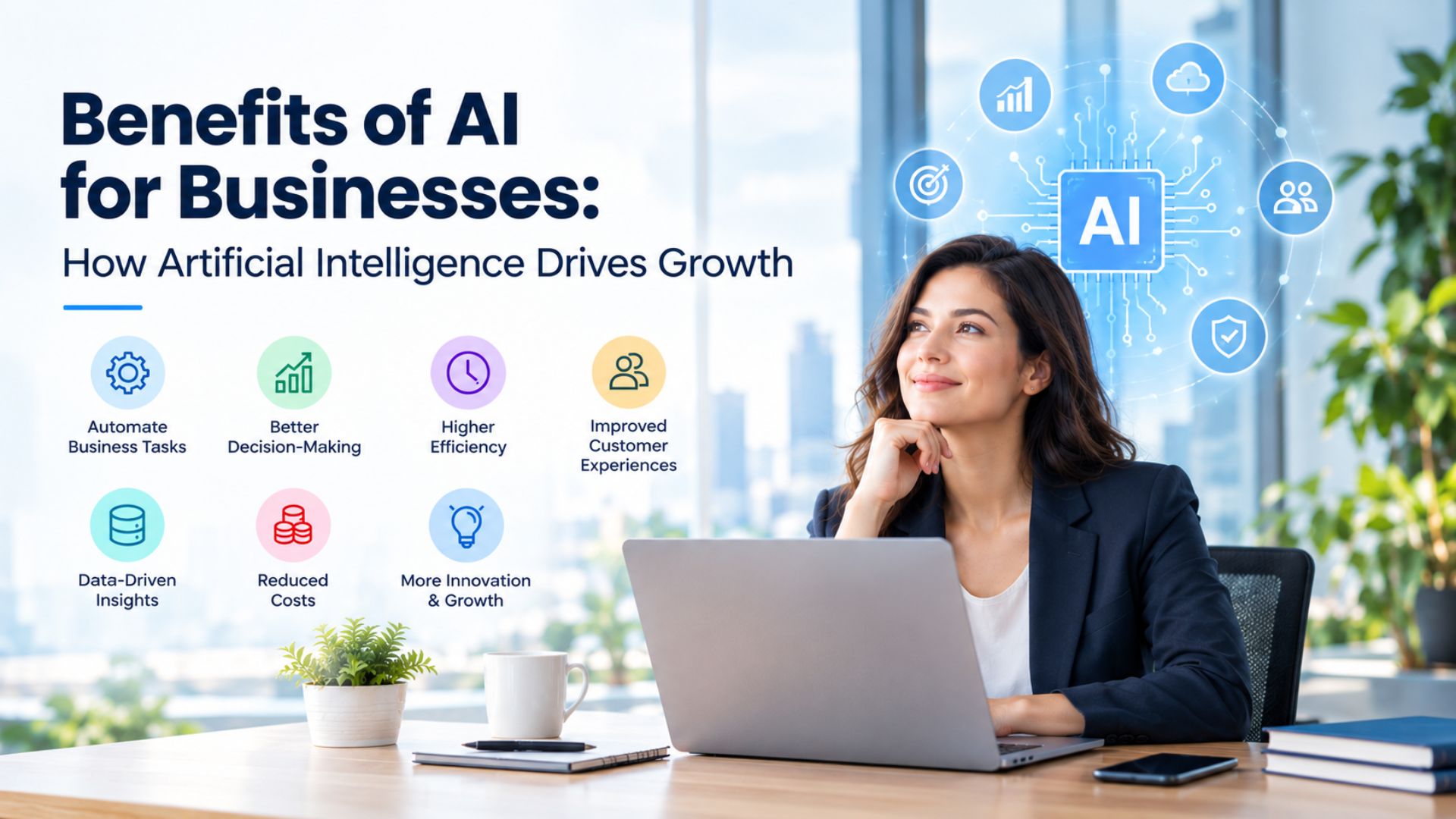
Artificial intelligence is changing the way businesses work, make decisions, and serve their customers. From automating repetitive tasks to finding useful patterns in large amounts of data, AI for business is becoming a practical technology for organizations across different industries and regions.
For some companies, AI may begin with a simple customer-support chatbot or automated workflow. For others, it can become part of a larger system for forecasting, personalization, data analysis, or operational management. The right approach depends on the business problem, available data, existing technology, and long-term goals.
At Brain Technosys, we see AI as a business tool rather than simply a new technology trend. Well-planned AI business solutions can help organizations improve everyday processes, make better use of their data, and build more responsive digital experiences.
What Is AI for Business?
AI for business refers to the use of artificial intelligence technologies to support business activities, solve operational problems, and improve how organizations work.
Unlike traditional software that generally follows predefined rules, AI-powered systems can analyze information, identify patterns, generate insights, make predictions, or respond to changing inputs. Depending on the use case, businesses may use machine learning, natural language processing, computer vision, generative AI, or other AI technologies.
For example, an organization may use AI to analyze customer behaviour, identify unusual transactions, forecast demand, answer common support questions, or automate document processing.
The important point is that artificial intelligence for business should be connected to a clear business need. AI does not automatically create value simply because it has been added to a software system. Its value comes from solving a real problem in a useful and measurable way.
Why Are Businesses Adopting Artificial Intelligence?
Businesses operate with increasing amounts of information and increasingly complex workflows. Employees may spend significant time handling repetitive tasks, reviewing data, responding to routine requests, or moving information between different systems.
AI can help reduce some of this manual effort while giving teams better access to useful information.
Common reasons businesses explore AI software solutions include:
- Automating repetitive and time-consuming tasks
- Supporting faster decision-making
- Understanding large volumes of business data
- Improving customer service and personalization
- Identifying patterns and potential business opportunities
- Improving operational efficiency
- Supporting forecasting and planning
For a global business, these benefits can apply across different markets, teams, and business models. However, the technology should always be selected according to the organization’s specific requirements rather than following a one-size-fits-all approach.
Key Benefits of AI for Businesses
The benefits of AI can vary depending on how it is implemented and where it is used. A customer-service system, for example, may deliver different value from an AI solution used for financial forecasting or supply-chain planning.
Automate Repetitive Business Tasks
One of the most practical benefits of business automation is reducing the amount of manual work involved in repetitive processes.
AI can assist with tasks such as document classification, data processing, customer enquiries, scheduling, content analysis, and routine workflow management.
This does not necessarily mean replacing human involvement. In many situations, AI works alongside employees by handling repetitive parts of a process while people focus on tasks that require judgement, communication, or domain expertise.
Improve Business Decision-Making
Businesses make decisions using information from sales, customers, operations, finance, and other sources. AI can help analyze this information and identify patterns that may be difficult to see manually.
For example, an AI system can support demand forecasting, customer analysis, risk identification, or sales predictions.
The final decision can still remain with business leaders and experienced teams. AI provides additional information that can make the decision-making process more informed and efficient.
Increase Operational Efficiency
When different business processes involve manual data entry, repeated checks, or disconnected systems, work can become slower and more difficult to manage.
AI-powered business solutions can help streamline selected processes by analyzing information, triggering actions, and assisting employees with routine work.
The result can be a more efficient workflow where people spend less time on repetitive activities and more time on work that contributes directly to business objectives.
Enhance Customer Experiences
Customers increasingly expect quick, relevant, and convenient digital experiences.
AI can support customer-facing services through intelligent chatbots, recommendation systems, automated responses, customer-data analysis, and personalized experiences.
For businesses serving customers across different regions, AI can also support scalable digital interactions while allowing organizations to maintain appropriate human support for more complex requests.
Turn Business Data Into Useful Insights
Businesses generate data through websites, applications, transactions, customer interactions, internal systems, and connected devices.
Simply having large amounts of data does not mean a business can easily use it.
AI can help organizations analyze data, recognize patterns, identify trends, and generate useful insights. These capabilities can support areas such as sales forecasting, customer segmentation, inventory planning, and operational analysis.
This makes AI software solutions particularly useful when a business already has valuable data but needs better ways to understand and use it.
Reduce Operational Costs
AI can contribute to cost efficiency when it reduces unnecessary manual effort, improves resource planning, or helps identify inefficiencies in business processes.
However, cost reduction should not be treated as an automatic result of AI adoption. Developing, integrating, maintaining, and monitoring an AI system also requires investment.
For this reason, businesses should consider the complete cost and expected business value before implementing an AI solution.
Improve Forecasting and Planning
AI can analyze historical and current information to support forecasting and planning.
Businesses may use these capabilities to estimate demand, understand customer behaviour, plan resources, or identify potential changes in business conditions.
Better forecasting does not eliminate uncertainty, but it can give teams additional information when planning future activities.
Support Business Innovation
AI can also help businesses develop new products, services, and ways of working.
For example, companies can use AI to create more personalized digital experiences, introduce intelligent features into existing applications, or develop new services based on data and automation.
For organizations considering custom AI software development, this can provide an opportunity to build AI capabilities around their own workflows and business requirements rather than relying only on generic tools.
How AI Helps Different Business Functions
The impact of AI is not limited to one department. Depending on the business model and available data, organizations can apply AI business solutions across marketing, sales, customer service, finance, human resources, operations, and technology.
AI in Marketing and Sales
Marketing and sales teams can use AI to understand customer behaviour, identify patterns, personalize communication, and support lead analysis.
AI can also help businesses analyze campaign data and identify which products, services, or messages are more relevant to particular customer groups. This allows teams to spend more time on strategy and customer relationships instead of manually reviewing large amounts of information.
AI in Customer Support
Customer support is another area where artificial intelligence for business can provide practical value.
AI-powered chatbots and virtual assistants can answer common questions, provide information, and help customers navigate routine requests. More complex issues can still be transferred to human support teams.
The goal is not simply to automate communication. A well-designed AI system should make support faster and more convenient while maintaining an appropriate level of human involvement.
AI in Finance and Accounting
Finance teams work with large amounts of structured information, making the field suitable for several AI applications.
Businesses can use AI to assist with transaction analysis, forecasting, anomaly detection, document processing, and other repetitive financial activities.
These applications can help finance teams identify information more efficiently while keeping appropriate controls and human review in place.
AI in Human Resources
HR departments can use AI to support activities such as employee data analysis, recruitment workflows, internal support, and workforce planning.
For example, AI can help organize information or automate routine administrative tasks. However, decisions involving people require careful oversight because automated systems can produce unsuitable results when data or processes are poorly designed.
AI in Supply Chain and Operations
Supply chains involve many moving parts, including inventory, demand, suppliers, logistics, and customer requirements.
AI can analyze historical and current information to support demand forecasting, inventory planning, process monitoring, and operational decision-making.
For businesses managing complex operations, these capabilities can help teams respond to changing conditions with better information.
AI in Software Development
AI is also becoming part of modern software development workflows.
Development teams can use AI to assist with code-related tasks, testing, documentation, analysis, and other activities. Businesses can also integrate AI capabilities directly into their own software products.
At Brain Technosys, this can include developing software where AI is built around a company’s specific workflows, users, data, and business requirements.
AI Business Use Cases Across Industries
The way AI is used depends heavily on the industry. A solution designed for an eCommerce company may have very different requirements from one designed for financial services or manufacturing.
AI for Retail and eCommerce
Retail businesses can use AI for product recommendations, customer behaviour analysis, demand forecasting, inventory planning, and personalized shopping experiences.
For an online store, AI can help analyze customer interactions and make product discovery more relevant.
AI for Healthcare
Healthcare organizations can explore AI for areas such as administrative automation, data analysis, patient support, and workflow management.
Because healthcare involves sensitive information and important decisions, AI applications need appropriate security, privacy, validation, and human oversight.
AI for Financial Services
Financial organizations can use AI to analyze transactions, support fraud detection, assess patterns, improve customer experiences, and assist with forecasting.
The exact application depends on the organization’s processes, regulatory requirements, data, and risk-management framework.
AI for Manufacturing
Manufacturers can apply AI to predictive maintenance, quality inspection, production planning, demand forecasting, and process optimization.
When AI is connected with operational systems and suitable data, it can help teams identify potential issues earlier and improve production workflows.
AI for Professional Services
Professional service companies can use AI to organize documents, analyze information, automate repetitive workflows, and support employees with research and knowledge management.
The most useful applications are generally those that address a specific workflow rather than adding AI simply for the sake of using new technology.
AI Automation vs Traditional Business Processes
Traditional business processes often depend on predefined rules and manual actions. These systems can work well when the process is predictable and the required inputs are clearly defined.
AI-based automation can handle situations where the system needs to analyze information, recognize patterns, classify content, make predictions, or generate a response.
For example, traditional automation might move an invoice from one system to another based on fixed rules. An AI-enabled process could additionally analyze the invoice content, classify it, identify unusual information, and route it for the appropriate review.
This does not mean every process needs AI. In many cases, conventional automation may be simpler and more appropriate. Businesses should choose AI when its capabilities provide meaningful value for the particular workflow.
How AI Supports Data-Driven Decision-Making
One of the important applications of AI for business is helping organizations make better use of their data.
AI systems can process large datasets and identify relationships, patterns, or trends that may require significant manual effort to uncover.
Businesses can use these capabilities for:
- Sales and demand forecasting
- Customer behaviour analysis
- Risk identification
- Inventory planning
- Performance analysis
- Predictive maintenance
- Business reporting
AI-generated insights should be treated as a support for decision-making rather than a replacement for business judgement. The quality of the result also depends on the quality, relevance, and availability of the underlying data.
AI for Customer Experience and Personalization
Customers expect digital experiences that are convenient and relevant. AI-powered business solutions can help organizations respond to these expectations.
Recommendation engines can suggest relevant products or content. AI assistants can respond to common questions. Customer-data analysis can help businesses understand preferences and interactions.
For companies serving customers across multiple markets, AI can also help support larger volumes of interactions while allowing human teams to handle situations that require personal attention.
Challenges of Implementing AI in Business
The benefits of AI are significant, but implementation also comes with practical challenges. Businesses need to consider technology, data, security, people, costs, and ongoing management before moving forward.
Data Quality and Availability
AI systems depend on data. Incomplete, outdated, inconsistent, or poorly organized data can affect the usefulness of an AI solution.
Before development begins, businesses should understand what data is available and whether it is suitable for the intended application.
Security and Privacy
AI applications may process business information, customer data, or other sensitive content.
Organizations need appropriate security measures, access controls, data-handling practices, and privacy considerations based on their industry and operating markets.
Integration With Existing Systems
Many businesses already use CRM platforms, ERP systems, websites, mobile applications, databases, and other software.
Integrating an AI solution with these systems can require careful planning. The AI component should fit into the existing technology environment instead of creating another disconnected system.
AI Skills and Workforce Training
Successful AI adoption involves people as well as technology.
Employees may need training to understand new workflows, use AI tools appropriately, review AI-generated results, and identify situations where human intervention is required.
Cost and ROI
AI implementation can involve development, data preparation, infrastructure, integration, testing, monitoring, and ongoing maintenance.
Businesses should therefore evaluate the expected business value alongside the initial development cost.
Responsible AI and Governance
Organizations also need clear processes for monitoring AI systems, managing risks, protecting data, and reviewing how automated outputs are used.
Responsible implementation becomes especially important when AI influences customer interactions, financial decisions, employment processes, or other areas involving people.
How to Implement AI in Your Business
A practical AI strategy usually starts with the business problem rather than the technology.
Identify a Business Problem
Begin by identifying a process where AI could provide measurable value. This could involve excessive manual work, difficult data analysis, slow customer support, or forecasting challenges.
Select the Right AI Use Case
Not every business problem requires AI. Compare possible solutions and determine whether AI provides capabilities that traditional software or automation cannot provide as effectively.
Assess Your Data
Review the data required for the proposed solution. Consider its quality, availability, security, structure, and relevance.
Choose the Right AI Technology
Depending on the problem, the solution may involve machine learning, natural language processing, computer vision, generative AI, or a combination of technologies.
Develop and Test the Solution
The AI component needs to be developed, integrated, tested, and evaluated against real business requirements.
Measure Results and ROI
After implementation, businesses should track relevant measures such as time saved, operational efficiency, customer satisfaction, accuracy, or other outcomes connected to the original business objective.
Scale AI Across the Business
Once an AI application demonstrates practical value, organizations can consider expanding it to additional workflows or departments.
Custom AI Software Development for Businesses
Generic AI tools can be useful for common tasks, but some organizations need solutions built around their own processes, data, systems, and users.
Custom AI software development allows businesses to create AI capabilities that fit specific operational requirements.
At Brain Technosys, the approach can involve understanding the business requirement first and then combining AI capabilities with software development, data, application architecture, and integration.
This can be useful for organizations looking to develop AI software solutions that become part of their existing digital ecosystem rather than operating as isolated tools.
How Much Does AI Implementation Cost?
The cost of implementing AI depends on factors such as the complexity of the use case, data requirements, AI technology, integrations, development effort, infrastructure, security, and ongoing maintenance.
A simple AI feature can have very different requirements from a complete enterprise AI platform.
For businesses planning a larger AI initiative, understanding these factors before development can make budgeting and planning more realistic.
The Future of AI for Business
AI is becoming part of a wider range of business applications. Generative AI, intelligent automation, predictive systems, and AI-powered software are creating new ways for organizations to work with information and serve customers.
The long-term value of AI will depend not only on the technology itself but also on how effectively businesses connect it with their processes, data, people, and goals.
For companies exploring AI, a practical starting point is to identify a genuine business need, evaluate the available data, and choose an implementation approach that can be measured and improved over time.
Frequently Asked Questions About AI for Business
What is AI for business?
AI for business means using artificial intelligence technologies to support business processes, analyze information, automate tasks, improve customer experiences, and assist decision-making.
What are the main benefits of AI for businesses?
Common benefits include business automation, improved efficiency, data analysis, forecasting, personalization, customer support, and decision-making assistance.
How can AI improve business operations?
AI can analyze information, automate repetitive activities, identify patterns, support forecasting, and help employees handle routine workflows more efficiently.
What industries can benefit from AI?
AI can be applied across industries including retail, eCommerce, healthcare, financial services, manufacturing, professional services, and many others. The appropriate use case depends on the organization’s requirements.
How much does AI implementation cost?
There is no single price for AI implementation. Costs depend on the complexity of the solution, data, integrations, technology, development requirements, infrastructure, and ongoing maintenance.
How can a business start using AI?
A business can start by identifying a specific problem, evaluating whether AI is appropriate, assessing its data, selecting a suitable use case, and testing the solution before expanding it.
What are the challenges of implementing AI?
Common challenges include data quality, security and privacy, integration, cost, workforce training, governance, and ongoing monitoring.
How can Brain Technosys help with AI solutions?
Brain Technosys can help businesses explore and develop AI-powered software solutions based on their specific business requirements, workflows, data, and existing technology environment.
Recent Posts
-

What Is AI Software Development? A Complete Guide for Businesses
September 11, 2026
-

Benefits of Custom Software Development for Modern Businesses
September 2, 2026
-

Hire the Best Angular Developers - Brain Technosys
August 21, 2026
-
-
Categories
- .NET development
- Agile Project Management
- AI development
- android app development
- Angular Developer
- Apps Development
- Bing Webmasters
- Blog Marketing
- Cloud Services
- Custom Software Development
- Digital Marketing
- E-Commerce
- Flutter App Development
- Google Adwords
- google map
- Google Update
- Google Webmasters
- Hire Developers
- HTML
- internet marketing
- Ios App Development
- iphone app development
- Local SEO
- magento development
- MEAN vs MERN Stack Development
- mobile app development
- Mobile Update
- News & Events
- PPC
- Search Engine Optimization
- Seo
- Social Media Marketing
- Tech
- Uncategorized
- Web Design
- Web Development
- Web Hosting
- WooCommerce Development


